Building Relationships

People. Business. Community.

Friday, April 15, 2011

2011 Perception Survey Results

Survey Sponsor and Research Company: African Women Connect
Objectives: to get feedback and perspectives from members, current and past participants, and target audience on organizational mission, vision, programs and services, performance and direction.
Audience description: mostly women of African descent living in the Twin Cities metro area
Sample size: 260 email addresses on AWC listserv of members, current and past participants, prospects and supporters
Dates of data collection: February to March 2011
Response size/rate: 32 or 12 %


Question 1. Heritage you most closely relate to


Question 2. Number of years you have lived abroad (US and elsewhere


Question 3. AWC mission and vision is relevant and timely

Mission – to create a network to empower women of African descent, linking them to valuable resources and promoting partnerships that strengthen individual and communal success.
Vision – we envision a world where African women are viewed and recognized as valuable contributors to society by themselves and others.


Question 4. Number of times you have participated in AWC events since 2004


Question 5. Reason(s) why you decided to participate in AWC (check all that apply)


Question 6. How valuable is AWC to you?


Question 7. In your opinion, what does AWC do well? (check all that apply)


Question 8. In your opinion, what areas should AWC focus on? (check all that apply)


Question 9. What keeps you from participating more than you currently do?


Question 10. What changes would you suggest in order to improve participation and organizational effectiveness?

A.       Time, so far has kept me from participating in AWC. The other factor is that, many times the meeting places have not been convenient, and also the purpose of the meetings has not been clear to me. The biggest challenge for me has been that I do not understand the structure of the AWC. What is the difference between a member and a non-member? What is the purpose of the membership fee? What are the benefits of being a member? What are the fees used for? How can one have a say in the group/organization, etc. It has never been clear to me. Otherwise, I like the concept, but it has never been clear to me where I can fit it.

B.       Participation - expand outreach to more women through wide advertisement and awareness. Organizational effectiveness - Have a clear organizational structure, with more delegation and involvement of more women who are consistent participants of AWC activities.

C.      Not really sure

D.      Location of the meetings; try to find a place where parking won't be a challenge (not always easy but I think people get discouraged if they think parking will be an issue) - Ask people to come up with topics of discussions - Allow people to share information on things they believe can help others. Clearly differentiate marketing and information sharing so there is no confusion and certain people don't feel the objective of the organization are in conflict with their values.

E.       I believe that AWC is doing a great job and will continue to attract more settled African women compared to new immigrants due the different needs of both. It may be beneficial to target African women professionals and business owners as they may be more open to the networking aspect of belonging to groups and organizations like AWC.

F.       AWC is already on track for doing that. More opportunities to interact with "power brokers" and professional development workshops would be a plus. Thanks for all that you already do.

G.      Don't have enough information at this time to make any meaningful suggestions.

H.      We haven't had any meetings lately. We need to meet a little more often. We are slacking off.

I.         Try and create more time to be able to participate.

J.        I'm new to the network through PAWPN Summit committee member.

K.      Somehow reengage participants from past years. I'm not quite sure how to motivate participants to become members.

L.       Not sure as my work hours are my biggest reason for not attending. Also, I've been having some problems with the invites, can't open them.

M.     More visibility. Reach younger population.

N.      AWC needs other larger organizations' support

O.      AWC should push towards less elitism so that it can reach more African women.

P.       I attended one AWC event it was organized with influential women from all walks of life. AWC is a great way for African Americans and African diaspora to connect.

Q.      Allow participants to present new ideas, information and opportunities to other members. This should include business opportunities and should not be considered marketing.

R.       Mix some free events in with the paid meetings like a weekend bookclub that focuses on women issues and interests.

Friday, March 18, 2011

The Results are In: 2010 ANNUAL REPORT


African Women Connect (AWC)
2010 Annual Report

About AWC
African Women Connect, LLC (AWC) promotes networking and relationship building for friendship, business and community. AWC also provides opportunities for personal development, sharing information and community involvement.
The Mission of AWC is to create a network to empower women of African descent, linking them to valuable resources and promoting partnerships that strengthen individual and communal success.
The Vision of AWC is a world where African women are viewed and recognized as valuable contributors to society by themselves and others.

2010 Summary/Highlights
A total of 96 individuals attended AWC-organized events in 2010, compared to 132 in the previous year. That amounts to a decrease of 36 or %27. Of the 96, 59 or 61% were unduplicated. In 2009, unduplicated participants were 79 or 60%. The membership goal was 25 women. A total number of 16 women (of 64% of goal) signed up. Nine (9) AWC-organized events were held in 2010; four (4) fewer than 13 events in 2009. Average meeting attendance was 11; two fewer than in 2009. Thirty participants or about 50% of unduplicated participants were new to AWC.  2010 participants represented 16 different countries of origin; four (4) more than in 2009. For the first time since AWC was established, more participants originated from the East African region. In previous years, the largest group of attendees originated from the West African region. The number of participants originating from South Africa doubled from two (2) to four (4) participants. In 2010, 71% of respondents to AWC Satisfaction Survey “Strongly Agreed” that participating in AWC events were time well-spent and the remaining (29%) “Agreed.”  AWC continues to operate at a loss. Income from membership and event fees were not enough to cover expenses or make a profit.

Participants
A total of 96 individuals attended AWC-organized events in 2010, compared to 132 in the previous year. That amounts to a decrease of 36 or %27. Of the 96, 59 or 61% were unduplicated. In 2009, unduplicated participants were 79 or 60%.

Members
The membership goal was 25 women. A total number of 16 women (of 64% of goal) signed up. AWC has put a hold on its membership campaign until results from the 2011 Perception Survey is reviewed and analyzed.
Members make up a bold group of women leaders who are blazing a trail by creating a new “rule book” for personal identity, professional achievement and community involvement in the African Diaspora. There are benefits provided to members.  Their involvement is important to building a community we can all be proud of. Their commitment and participation in AWC efforts, events, and activities creates a better community where we can all learn, hone skills and enjoy the process of discovering who we are together, and how we can interact and work together as African women.

Events
Nine (9) AWC-organized events were held in 2010, four (4) fewer than 2009 total of 13 events. Average meeting attendance was 11, two fewer than in 2009. Thirty participants or about 50% of the number of unduplicated participants were new to AWC.  2010 participants represented 16 different countries of origin, four (4) more than in 2009. They included Cameroon, Ethiopia, Eritrea, Gambia, Kenya, Liberia, Madagascar, Nigeria, Rwanda, Sierra Leone, Somalia, South Africa, Tanzania, Togo, the Caribbean, and the United States. New from previous year were Gambia, Eritrea, Tanzania and the Caribbean.
Topics included goal-setting, ethnic food drive, community leadership, personal and professional coaching, board leadership, friendships, domestic violence and breast cancer, among other things. One of the events provided participants the opportunity to volunteer with locally-based nonprofit supporting orphans in Africa. AWC utilized and supported four (4) community businesses/organizations by hosting its events on their premises.
For the first time since AWC was established, more participants originated from the East African region. In previous years, the largest group of attendees originated from the West African region. The number of participants originating from South Africa doubled from two (2) to four (4) participants.
Satisfaction Survey
Events attendees are provided the opportunity to provide feedback after each event. In 2010, 71% of respondents strongly agreed that participating in AWC events was time well-spent and the remaining (29%) agreed as well. Comments received included (as written by the women):
·         Great time meeting ladies from other parts of Africa. Dearly enjoyed the company.
·         I had a pleasant time at the dinner. The women were nice, and I felt welcomed. I will try to go whenever I can.
·         Got a chance to network and meet new people
·         Great, met some new people, and re-connected with those I know already but have not seen for a while
·         Relaxing, the more I come to AWC events and meet like-minded people, the more reason I do not want to miss any of their events.
·         It was great to connect with old friends and new people. There was a lot of energy in the room. Great Vibe!
·         I met new and existing African sisters. The atmosphere was relaxed and inviting to conversations and getting to know the women in attendance.
·         It feels so good to be surrounded by such kind, intelligent women. I had a fun night, "I was not faking it".
·         It was great to see such a diverse group of accomplished African women.
·         Had a great time meeting many new women from varied backgrounds
·         Sisters Gathering over Meal. Splendid!
·         It was great. Inspiring.
·         Was an informative evening

Financial
AWC continues to operate at a loss. Income from membership and event fees were not enough to cover expenses or make a profit. We continue to investigate strategies to help us break-even and eventually become profitable. Imagine what we could achieve with financial support! We remain optimistic.

Refugee and Immigrant Women for Change (RIWC) International Women's Day Event

Dance performance of true stories of refugee and immigrant women.

The Refugee and Immigrant Women for Change (RIWC) International Women's Day event was held on March 8, at the University of St. Catherine from three o'clock to six-thirty in the evening. A crowd of approximately two hundred people, mostly women, youth and men of different backgrounds from ethnic and mainstream communities were in attendance. I, personally, was glad to see that refugee and immigrant women were present at the the table and fully participating in every aspect of the event.

RIWC is a coalition made of seven ethnic-community-based organizations (Asian, African and Latino), formed around the shared vision of fostering organizational leadership, community accountability and capacity-building of member organizations around gender equity for refugee and immigrant women. Learn more...

Welcome and opening remarks were made by Dr. Alan Silva, St. Catherine's Dean of the School of humanities, Arts and Sciences, and Mariam Mohamed, community advocate and board member of CAPI (RIWC member organization.

The main attraction was a dance performance choreographed to stories of refugee and immigrant women collected through eighteen focus groups and about one hundred and sixty-five participants (women, men, youth). The performance was entitled “We Are Not Below the Men: Riwa meets Kartee.” I thought the performance was very powerful. Even more powerful were the stories shared by participants of RIWC focus groups. You had to be there to see it and experience it for yourself.

As I watched the performance and listened to the stories, I jotted down some themes that ring true for many in our communities—hope they make sense to you:

  • Many refugees and immigrants come to America in search of opportunities and “a better life” but...
  • Some men feel frustrated about not doing (or having the ability to do) enough to support their families—they feel a strong sense of failure
  • Some women hear—“you don't need a man to be a success in this country”
  • Some women feel lonely and depressed--- not feeling taken cared of; no respected
  • Sometimes divisions build between the old and the young, the men and the women, the parents and the children
  • Some people look to religious leaders and institutions to keep the peace in their households, relationships and marriages
  • Some men feel powerless
  • Some elders feel disrespected, diminished, invisible
  • Sometimes education (in different forms) can be a huge barrier to success
  • Sometimes we (as individuals) are not always aware of our anger, depression or feelings of hopelessness
  • Sometimes we are pleasantly surprise that the “old way” of doing things can actually produce positive results in these modern times—it reminds us not to be too quick to dismiss ideas from the “village”
  • Sometimes we believe that the only way to succeed is through formal education—and we hang a lot (sometimes way too much) on that idea
  • Some youngsters feel pressured to succeed—the entire family is watching and waiting...
  • Some people step up to leadership even when they are not asked or when it involves serious sacrifices because they feel that “someone” has to “take care of our people”
  • Sometimes we come to the conclusion that our children will learn in their own time
  • Sometimes we are as proud of our daughters as we are our sons
  • Sometimes we are confident that nothing can stand in the way of our success
  • Sometimes we realize that we are doing the best we can; we can all work together; not on the top or the bottom but side by side
  • Sometimes we get it---this America we now call home has its problems and its rewards too.

The performance and stories affirmed a lot of what I already knew. However, the real highlight of the event was the community dialogue. As a facilitator, I enjoyed the opportunity to really listen and encourage people to share their thoughts, insights and ideas about gender equity for refugee and immigrant women and RIWC in general.

One gentleman at my table summed it nicely, I thought. He said that our lives are full of complexities and social service organizations and experts are only now beginning to learn that we can't just fix one thing and send the individual on his or her way, we need to take a holistic approach and spend more time understanding.

I believe that community dialogue is always a great start for “understanding.”

News Release: African Women Connect (AWC) Introduces New Spotlight Column to Help Community-based Businesses, Organizations and Leaders Tell their Story

For Immediate Release
March 10, 2011

612-250-8478


African Women Connect (AWC) Introduces New Spotlight Column to Help Community-based Businesses, Organizations and Leaders Tell their Story


MINNEAPOLIS, Minn – AWC is responding to a community need for no to low cost marketing for small businesses, organizations and community advocates that have a tough time getting the word out about their existence, products and services. The new spotlight column will be an addition to AWC monthly e-newsletter that goes out to a cross-section of mostly African ethnic groups, including members of the mainstream population.

Community-based businesses require the support of community members to keep their doors open. Marketing is always a challenge for small businesses and even more so for ethnic minority businesses. In most cases, people in the community are just not aware that these businesses exist. With limited budgets and a challenging economy, investing in marketing is usually not top priority but nevertheless critical for business survival.

“We have been supporting community businesses several years and we are proud of this  initiative. However, an ongoing challenge has been finding such businesses and once we do, hoping that they would stay in business long enough to continue our support. Word of mouth is the primary way community-based businesses get the word out and we have seen time and time again that sometimes it is just not fast enough to keep the doors open,” says Rita Apaloo, AWC founder and president. “We hope that this will be a another avenue to continue our initiative of supporting our community.

A separate blog site will be established to keep the stories posed for business owners and the general public to continue to access. AWC will rely on its e-newsletter audience to help advertise this opportunity to community-based businesses. Anyone interested or would like more information about the project should contact AWC at africanwomenconnect@hotmail.com or 612-250-8578. Interested participants will be asked to respond to ten questions and provide a photo or logo. AWC hopes to have the first business spotlighted in its April newsletter.

About AWC

African Women Connect, LLC (AWC) is a Minnesota-based organization that promotes networking and relationship building for friendship, business and community. AWC also provides opportunities for personal development, sharing information and community involvement. More at www.africanwomenconnect.net.

###

Wednesday, November 10, 2010

Pink & Purple Event brings awareness to Breast Cancer & Domestic Abuse


President of the African American Breast Cancer Alliance, Reona Berry, presents to attendees.

On Friday, October 22, AWC held its annual Pink & Purple event. Breast cancer and domestic abuse/violence are important topics that affect women and families and that’s why we provide the opportunity for a culturally-sensitive and open group discussion for African women. 

Our Speakers, Reona Berry, 20-year breast cancer survivor and president of the African American Breast Cancer Alliance (AABCA), and Kelly, a domestic abuse volunteer with Alexandra House, an emergency shelter for battered women and children, came prepared with good information and handouts to share. A big thank you to both ladies!

We are thankful for all who attended--your presence helped us hold our end of the bargain to provide an engaged audience for our speakers and partners who take the time away from their busy schedules to share valuable information with our group. We always want to be appreciative and respectful of their time and talents.

At the end of the meeting, one of the ladies said, “Every time I think I know all there is to know about these topics (breast cancer and domestic abuse/violence) I learn something new.” That usually rings true at every AWC meeting where we provide information. Even when the information is not entirely new, at least we get reminded of how important it is to be aware of these things and to know what to do or how to help when the need arises.


Here are a few pointers from the event:

  1. Take charge of your health and well-being.
  2. You can try to ignore cancer but it can’t ignore you—educated yourself and do your self-exam.
  3. We women need to know that it is okay to seek help and accept support from others when needed.
  4. The more you know the better you are.
  5. Domestic violence crisis hotline provides an avenue to talk and ask questions without judging; they also provide legal advocacy and safety planning.
  6. Domestic abuse is more than physical abuse—hitting (verbal, emotional, etc.)
  7. In some cases, men are the victims.
  8. Be proactive-- know what a healthy relationship looks like.
  9. Pay attention and get involved at some level even when you’re not the one in need of help. Others need your support.
  10. Build a network of people you can trust and rely on—be there for them and allow them to be there for you too.

Tuesday, September 28, 2010

All Dolled Up at the 2010 African Awards

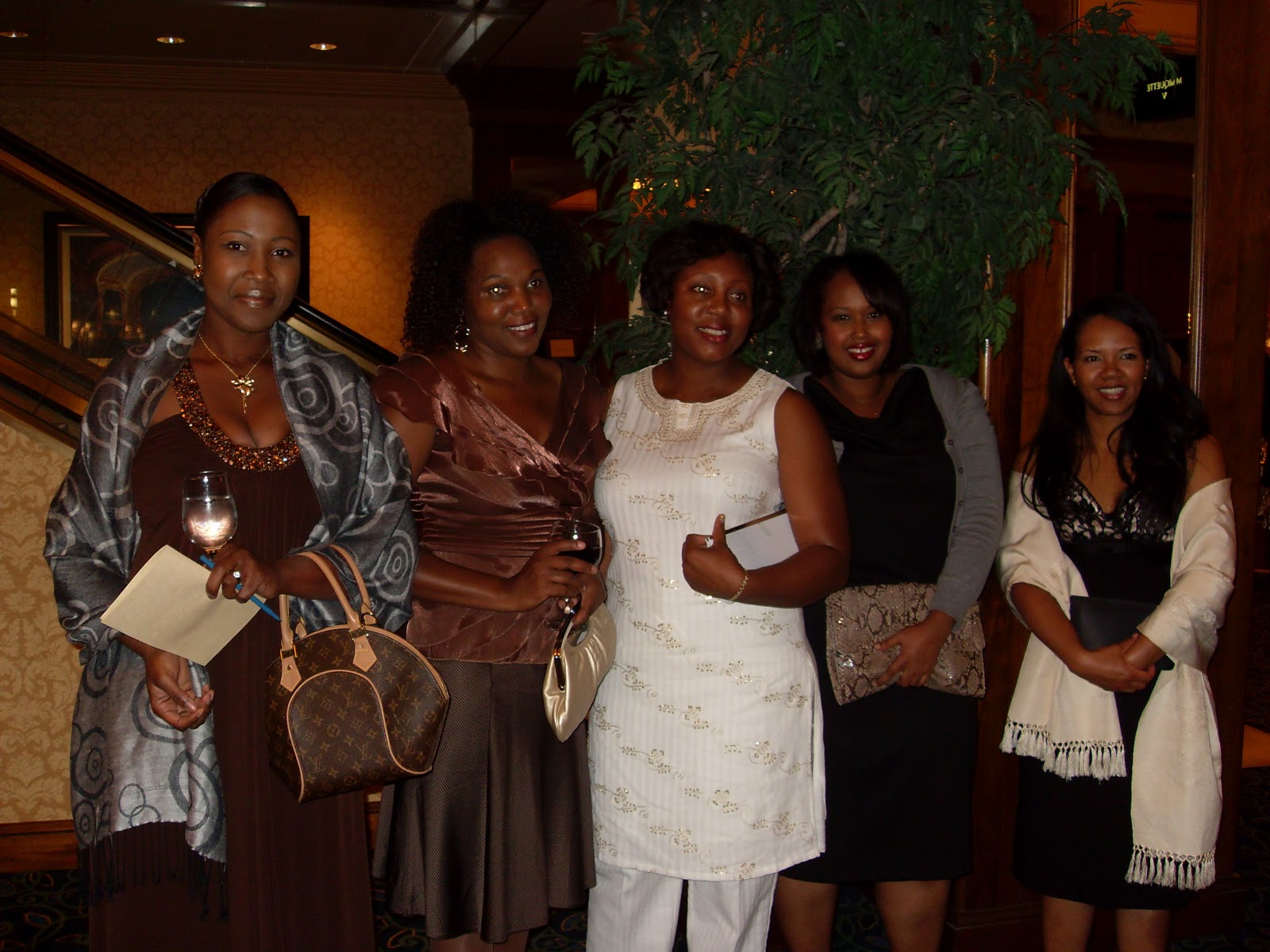
Which camera? Ama, Lydia, Rita, Ayan, Felicia

It is always exciting to see AWC members and friends out and about in the community. When we run into each other, we can't help but take an AWC Moment to catch-up on life events. The Mshale African Awards was no different. The ladies clean up real nice...don't you think?

Ayan and Felicia

Rita, Melissa (MAWA) and Ama

Rita and Celebrity News Anchor Robin Robinson

First Member-exclusive Event

Members (Wokie, Beatrice, Ama, Liz and Julia) enjoy a relaxed, cozy and fun time together.

After five years of “getting the word out,” engaging hundreds of women from over 20 different countries, and testing the waters to see what works and what doesn't, AWC launched a campaign to sign up a total of 25 paid members by December 2010.

At a little over 50 percent of its campaign goal, AWC had its first member-exclusive event on Friday, September 17. The event was held at AWC President's home. “This is like hitting the start button again,” Rita said. “The first AWC meeting began right here in this room, February 2004, and it feels good to begin a new chapter in the same space.” As always, not every member could make it due to schedule conflicts.

The meeting was meant to discuss business, as in where AWC has been and where it is headed. We were hoping to get valuable input from the members on the direction of the organization and future programming. Needless to say that business talk did not progress as planned. The relaxed and cozy home atmosphere made it difficult to want to discuss business especially after a long workday. After trying unsuccessfully to discuss serious matters, we gave up and did what we do best—socialize and have fun. We had a wonderful time.

Throughout all the chatter and laughter, we managed to review our member handbook, which includes guidelines and facts about AWC among other things. One important point of dicussion was the move from spending a lot of time and energy on organizing events to focusing on member benefits and needs. Things will start to look and feel different for AWC members and friends in the coming months and we plan to make the transition as smooth as possible while still providing unique opportunities for growth and networking.

We are excited about bringing together a talented group of women who are willing to commit to working together to take AWC to a higher level of leadership, and in the process become ambassadors for AWC mission and vision!

Beatrice and Felicia. What's a get-to-gether without good food?
Before we go...Liz, Ama, Rita, Beatrice, Mimi and the kids got in too!